
How to play Anvor
 How to play Anvor
Everything you need to choose a homeland, develop each territory, move across the map, fight, and win.
Goal, players, and map
Anvor supports 2–8 civilizations. A map contains 5, 10, 15, 20, or 25 tiles per player and is generated with connected terrain, fertile regions, and mountain ranges.
Players choose starting tiles in a random order. A homeland must contain land and cannot touch another homeland. It begins with 100 Labor and 250 Food. The last civilization that owns territory wins.
Reading a tile
- Land describes usable ground and determines whether a tile can be a homeland.
- Fertility increases food production and automatic Labor growth.
- Minerals determine mining output: Stone at all levels, Iron from 4+, and Gold from 9+.
- Forest multiplies Lumber output.
- Labor works actions, grows, migrates, and defends in groups of five.
- Military conquers and defends. Military that is not sent away also contributes to the tile's workforce.
- Defense makes the territory harder to attack. Science improves combat and can spread locally. Culture is one shared civilization score.
Resource guide
- Food supports population. Each turn a tile needs 1 Food per 10 combined Labor and Military, rounded up.
- Wood builds Defense at 100 Wood per point.
- Stone builds Defense at 10 Stone per point.
- Iron improves your civilization's combat rolls according to total Iron divided by total Military. Iron proportional to defeated Military is left on the battlefield.
- Gold hires Military mercenaries at 1 Gold each.
Transport can move any of the five resources between neighboring friendly territories.
Plan every territory
Every owned tile receives exactly 10 action points each turn. Divide them among Hunt and Harvest, Lumber, Mine, Train Military, Research, and Sanctify. Configure every tile, then mark your civilization ready.
A yellow dashed outline means the tile still needs actions. A green dashed outline means its previous plan is available to reuse. A red dashed outline warns that stored Food is below the tile's next maintenance cost; red and yellow may appear together.
Action results
- Hunt and Harvest: produces Food from workforce, points, and Fertility.
- Lumber: produces Wood from workforce, points, and Forest.
- Mine: produces Stone, plus Iron on Mineral 4+ tiles and Gold on Mineral 9+ tiles.
- Train Military: converts Labor into Military.
- Research: adds local Science.
- Sanctify: adds to the one Culture score shared by every tile you own.
Research, Sanctify, and training produce roughly 1 point per 100 workforce for each action point. Gathering scales with the matching terrain value and varies by up to 20% each turn.
Growth, supplies, and depletion
After production, Labor grows automatically by the tile's Fertility percentage, rounded up. Growth uses the Labor present after movement. Then the tile consumes Food equal to 10% of Labor + Military, rounded up.
If Food is short, the missing amount kills that many people, divided proportionally between Labor and Military. Forest drops by 1 for every 1,000 Wood extracted. Minerals drop by 1 for every 1,000 units of the tile's current primary mineral extracted.
Fortifications and mercenaries
Manual fortification happens before combat. Manual mercenaries cost 1 Gold each and arrive before combat. Auto-build switches spend complete bundles after gathering, and Auto-hire spends all Gold available after gathering, preparing the tile for the next turn.
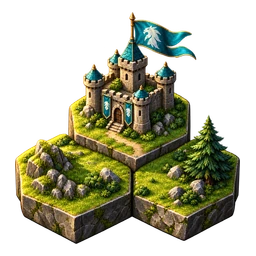
Spend complete bundles of 100 Wood or 10 Stone for +1 Defense. Occupied tiles show 1–4 stone battlements for Defense and 1–4 banners for Military: 1–20 shows one, 21–40 two, 41–100 three, and more than 100 four.
Conquer, Migrate, and Transport
Click a tile for its action menu, or press and drag from a tile to a neighboring tile to choose the destination first.
- Conquer sends Military. Friendly targets receive reinforcements; enemy and neutral targets start combat.
- Migrate sends Labor. Movement to your own tile is peaceful; movement into contested land fights in groups of five Labor.
- Transport moves Labor, Military, and resources to a neighboring friendly tile. Each moving person—or person already moving on the same route—carries up to 10 resources.
Orders do not spend action points, but you cannot send more people or resources than the source contains.
Combat
Each Military unit and each group of five Labor rolls a ten-sided die each combat round. A modified result above 8 scores a hit. Your Science and civilization Iron improve attacks; the opponent's Science, shared Culture, and tile Defense reduce them. Initiative determines an opening volley when forces meet.
Defense falls during battle as defenders are lost: losing all defending Military and Labor groups removes one-third of the starting Defense, with proportional loss after each casualty. Neutral tiles defend with 10 Military. A conquered neutral tile gains native Labor equal to 5 × Fertility. When a player tile falls, 75% of its pre-battle Labor survives under the new ruler.
Culture at borders
At the end of every turn, each border shared by opponents is resolved once. Both civilizations roll 1–10 and add their shared Culture. Divide the score difference by 100 to get the percentage converted from the losing border tile to the winning one.
That percentage of Labor, Military, Food, Wood, Stone, Iron, and Gold moves across the border, rounded down per category. The rate cannot exceed 100%. A tied score moves nothing.
Science spread
Science belongs to individual tiles. At the end of the turn, a tile gains +1 Science for every friendly neighboring tile whose Science is more than 110% of its own starting Science for that spread step. A fully surrounded tile can gain up to +6 Science.
Turn order
- Manual fortification and mercenary hiring
- Conquer, then Migrate, then Transport
- Research, Sanctify, Mine, Lumber, Train Military, then Hunt and Harvest
- Automatic Labor growth and Food maintenance
- Automatic fortification and mercenary hiring
- Science spread and border Culture conversion
- Defeat and victory checks
The board then replays public movement, combat, and captures without revealing force totals, followed by any defeat or victory announcement.
Score, defeat, and victory
Your score is total Labor + Military + Defense + Iron + Gold, plus 10 × every tile's Science and 10 × the civilization's shared Culture.
You are defeated when you own no tiles and may continue watching. The last player with territory wins Anvor by conquest. If no human-controlled civilization remains, AI execution stops and the game ends.
Beginner strategy
- Choose a fertile homeland with useful Forest or Minerals; early population and Food compound quickly.
- Keep a Food reserve before training or hiring a large army because Military also increases maintenance.
- Do not send every soldier away: idle Military defends and contributes to production.
- Use manual defenses or mercenaries for the current battle; automatic spending prepares the next turn.
- Transport Food, Iron, and reinforcements before a front line runs short.
- Build Science near likely battles and Culture along borders, but remember that territory—not score—wins.